
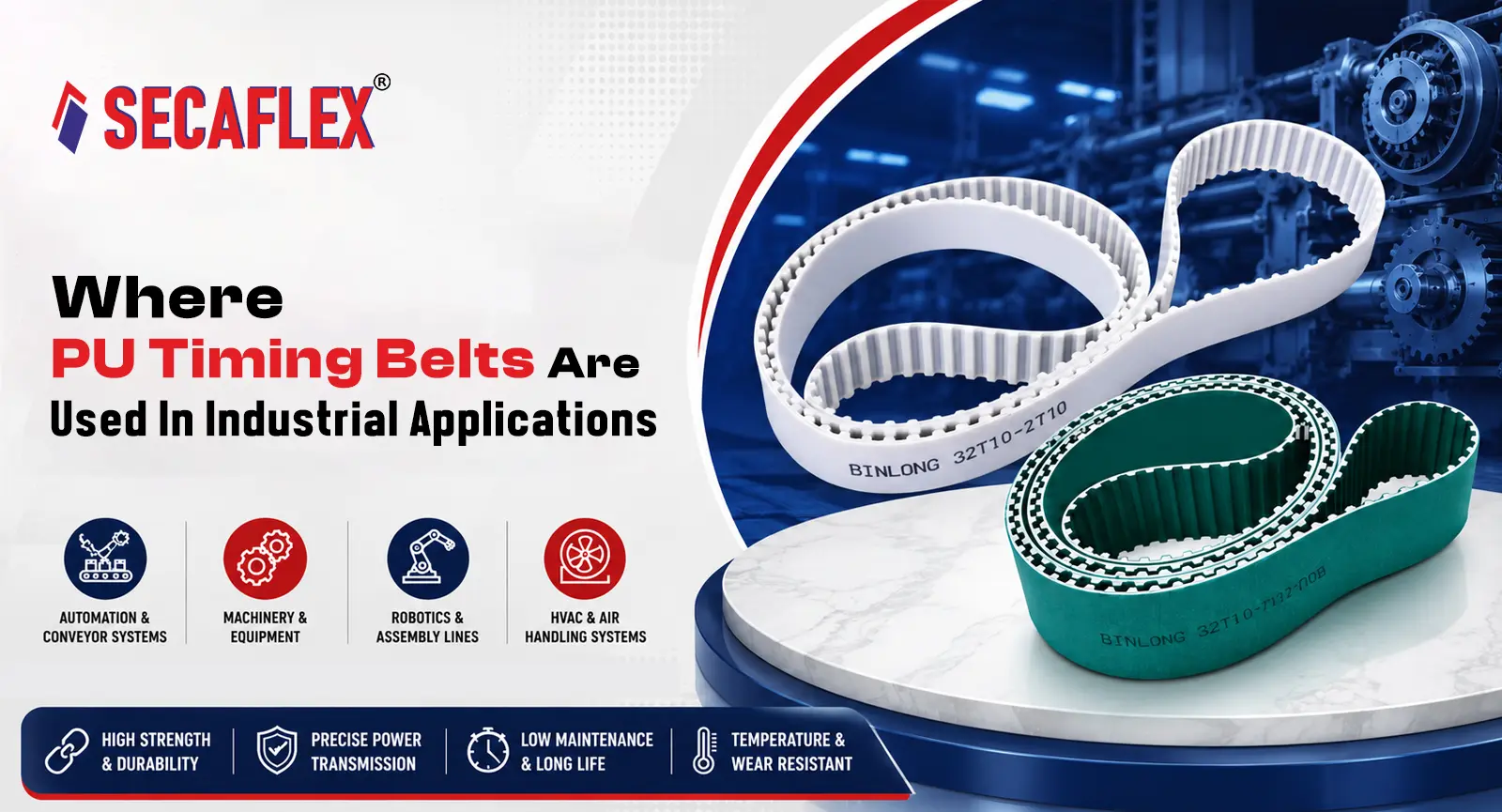
Quick Summary: A PU timing belt does one thing extremely well: keeping motion precise and synchronised without slipping, stretching, or needing constant lubrication. This article covers where these belts get used across industrial settings, what makes them the right fit for those applications, and what to check before specifying one for a new project.
Table of Contents
Introduction
In any factory where machines must move in perfect sync- robot arms picking components, conveyors indexing products, spindles driving tools- there’s almost always a timing belt hidden inside the drive system. More and more, that belt is made from polyurethane rather than traditional rubber. The PU timing belt has become a go-to choice for precision motion, harsh environments, and long service life.
So where do these belts show up, and why do they win out over rubber or chain drives in certain work? This article gets into the main places you’ll find them at work in industry, what makes them the better choice in those situations, and a few things worth keeping in mind whether you’re specifying one for a new setup or just trying to keep an existing one running well.
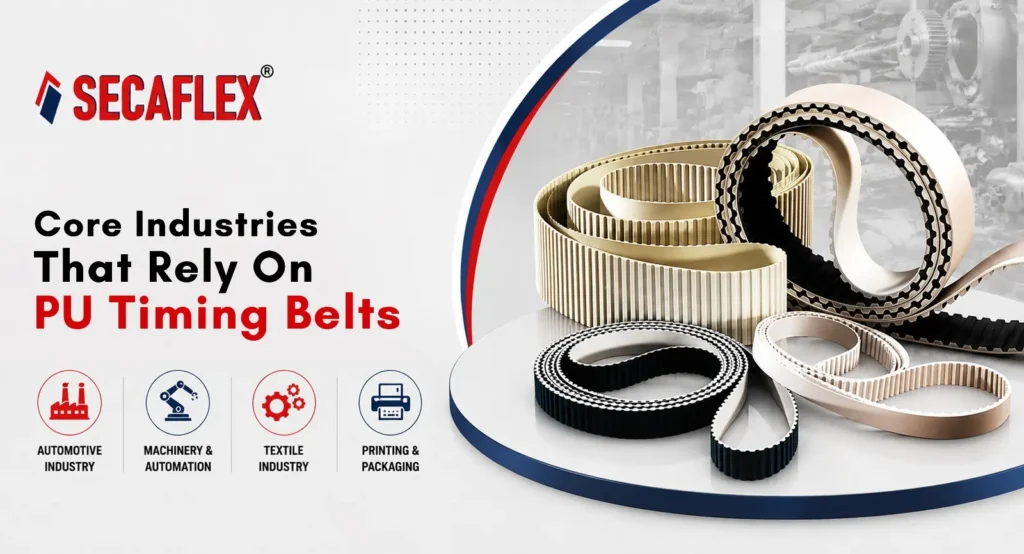
Core Industries That Rely on PU Timing Belts
Packaging and Labeling Machinery
Packaging lines move fast, and everything on them has to stay in exact rhythm with everything else. That’s the environment PU timing belts were made for.
- Labeling machines lean on precise belt timing to get labels exactly where they’re supposed to go. Even a tiny bit of drift, and you end up with crooked or misaligned labels on the finished product.
- Filling and capping lines use these belts to keep product movement in sync with the nozzles or capping heads. Without that sync, you’re looking at jams or misalignment instead of steady throughput.
- Cartoning and case-forming equipment depends on multiple stations moving together in perfect sync. How well the folds and seals line up comes down to how dimensionally stable the belt is.
PU belts hold up well in this environment partly because they resist the stretching that would gradually throw off timing in a less dimensionally stable belt material, keeping calibration accurate over long production runs.
Printing and Textile Equipment
Printing and textile machinery both depend on extremely consistent, repeatable motion, since even minor timing variation shows up directly in the finished product.
- Printing presses use PU timing belts to keep print heads or rollers in sync with the material feed. Any drift there shows up immediately as misaligned print registration.
- Textile machinery, things like looms and knitting equipment, benefits a lot from how little these belts stretch. That keeps tension and timing steady even across long, continuous production runs.
- Embroidery machines depend on precise, repeatable motion to place stitches correctly. How accurate the pattern turns out comes down to how well the timing belt stays in sync.
In both industries, the cost of timing drift isn’t just mechanical wear; it shows up as visible defects in the final product, which makes belt reliability a genuinely important specification, not a minor detail.
Linear Positioning and Robotics
Automated positioning systems need timing belts to turn a motor’s rotational movement into precise linear motion, and PU belts have become the standard pick here for good reason.
- CNC machines and linear actuators use timing belts to move components along a fixed axis with repeatable accuracy. Any positioning error there shows up directly in part quality.
- Pick-and-place robotics rely on belt-driven axes to move fast and land accurately between positions. Speed and precision both matter here at the same time, and the belt has to deliver on both.
- 3D printers use smaller PU timing belts to control how the print head moves. Even a small amount of backlash or slippage shows up as visible layer misalignment in the finished print.
What makes these belts so appealing here comes down to one combination: they offer strong positioning accuracy while running quieter and needing less upkeep than chain-driven alternatives. That matters a lot in settings where steady, low-noise operation is genuinely valued, not just nice to have.
Conveying and Material Handling
Beyond precise positioning, PU timing belts also handle the more everyday work of conveying, where keeping multiple points moving together still matters.
- Multi-strand conveyor systems rely on timing belts to keep parallel belts perfectly in sync. Without that, products can shift or end up misaligned partway through transport.
- Indexing conveyors need that same precise timing to stop products exactly where they’re supposed to. That matters for inspection, assembly, or whatever packaging step comes next.
- Sorting systems depend on that synchronised movement to get products to the right output point. Get it wrong, and you’re dealing with jams or items ending up somewhere they shouldn’t.
What to Check Before Choosing One
A few practical factors determine whether a PU timing belt performs well in a specific application. The following are the things that one should check before choosing the belt:
- Load and speed requirements, since belt width and tooth profile need to match the actual torque and speed demands of the system.
- Operating environment, particularly temperature extremes or exposure to chemicals, oils, or moisture that could affect belt material longevity.
- Reinforcement type, since steel-corded belts offer higher strength for heavier loads, while aramid-corded options often provide better flexibility for smaller pulley diameters.
- Pulley compatibility, confirming tooth profile and pitch match precisely, since mismatched components lead to premature wear regardless of belt quality.
Conclusion
PU timing belts show up across packaging, printing, robotics, and conveying applications because they deliver exactly what these applications need: precise, repeatable motion. Getting the reinforcement type, tooth profile, and pulley match right for the actual application separates years of reliable performance from frequent, avoidable replacement. At DKT Engineering Enterprises, that match between application demands and belt specification is central to every recommendation made, helping industries keep their equipment running exactly on time.
FAQs
My timing belt keeps drifting out of sync even though it looks fine, what’s going on?
Is it overkill to use a PU timing belt for something as simple as a basic conveyor?
Why do PU timing belts show up so often in food packaging specifically?
Can a PU timing belt handle sudden load spikes, or does it need a consistent, steady load to perform well?
How do I know if backlash in my 3D printer or CNC machine is a belt problem or something else entirely?

DKT Engineering Enterprises
DKT Engineering Enterprises has vast experience in manufacturing conveyor belts in India. We are providing high quality products to our clients Since 2010.
About Author

DKT Engineering Enterprises
DKT Engineering Enterprises has vast experience in manufacturing conveyor belts in India. We are providing high quality products to our clients Since 2010.