
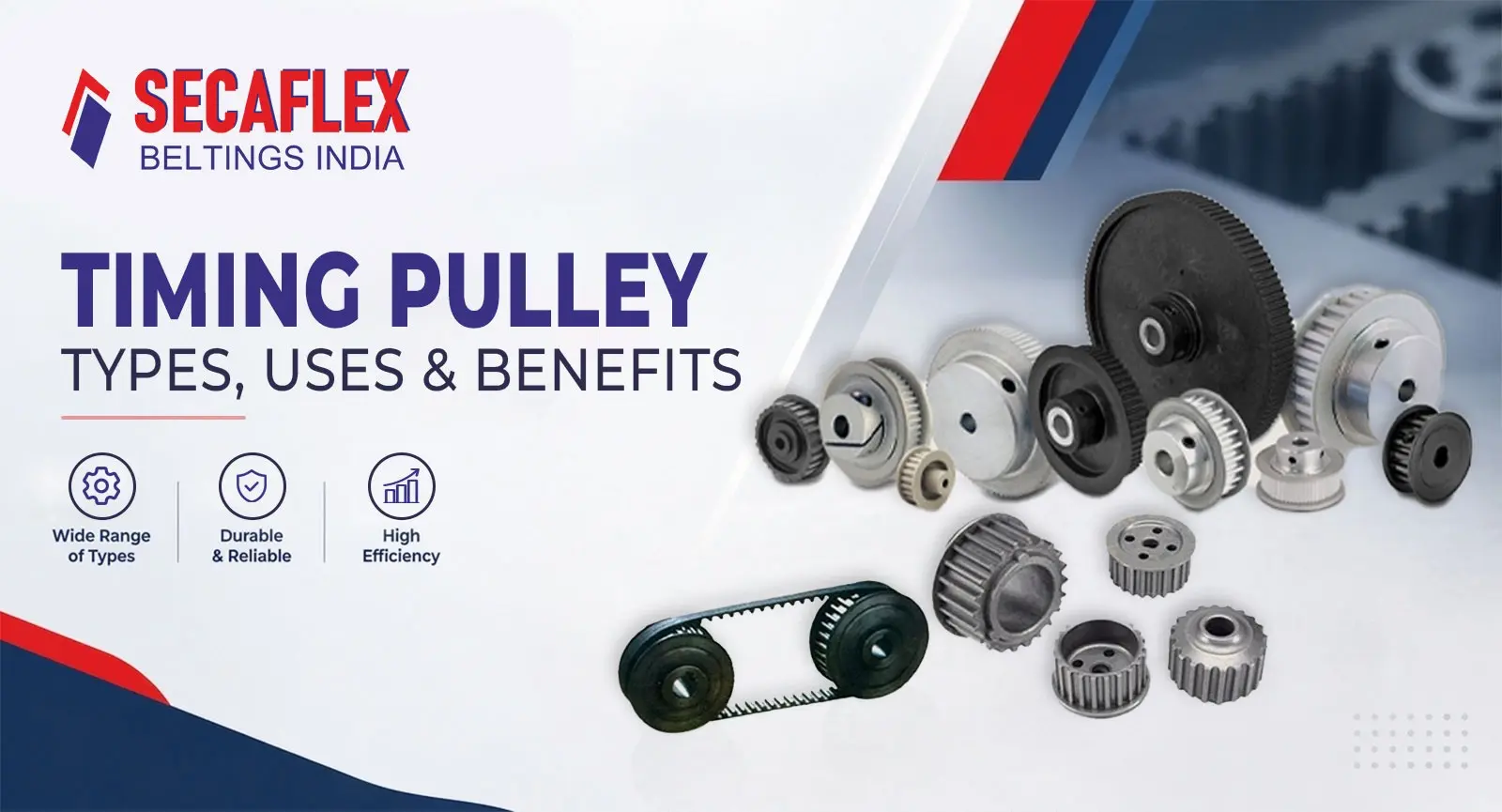
Quick Summary: A timing pulley is a toothed wheel that locks into a matching timing belt to transmit rotary motion between shafts without slipping, even under shifting loads. This article covers how that tooth engagement actually works, the pitch profiles worth knowing before you specify one, where these pulleys are used across industry, and the mismatch that causes most premature failures.
Table of Contents
- Introduction
- What Makes a Timing Pulley Different From an Ordinary One
- How the Teeth Keep Everything in Sync
- The Pitch Profiles Worth Knowing
- Where These Pulleys Are Used
- Belts and Pulleys vs Chains and Gears
- Getting the Specification Right the First Time
- Common Mistakes That Cause Early Failure in The Timing Pulley
- Conclusion
Introduction
Two shafts, spinning in perfect sync, no space for even a fraction of a degree of drift; that’s the exact problem a timing pulley was built to solve. A plain pulley relies on friction to grip a belt, and friction always has a breaking point; push it hard enough and the belt slips, timing is lost, and whatever depended on that precision – an engine, a robotic arm, a CNC tool- starts falling out of step. A timing pulley skips that risk entirely by using teeth instead of grip, locking the belt and pulley together so slipping simply isn’t an option. It’s a small mechanical idea with an outsized payoff, and it’s exactly why this pulley has become one of the most trusted components in precision machinery.
What Makes a Timing Pulley Different From an Ordinary One
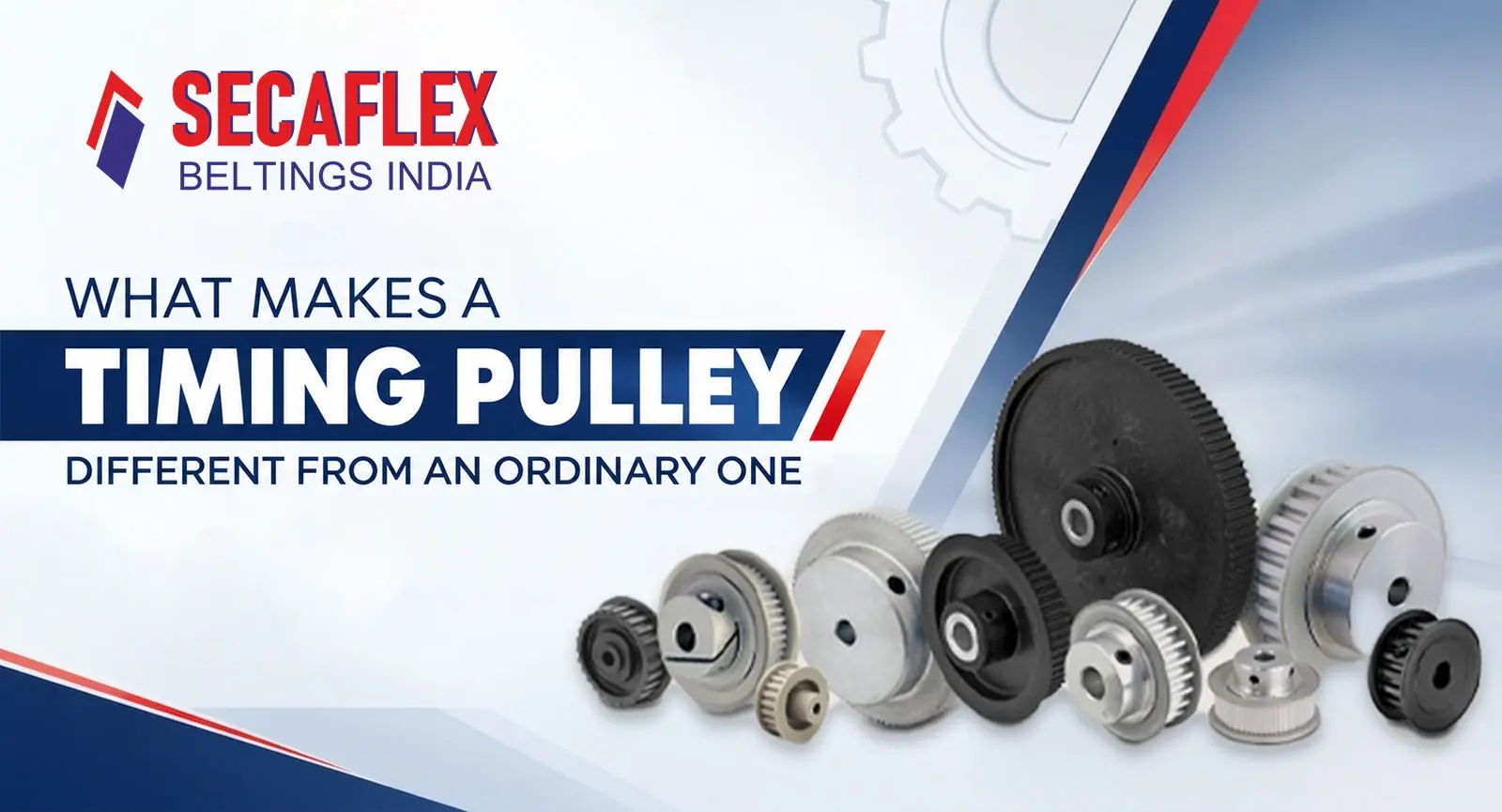
A timing pulley carries evenly spaced teeth around its outer edge, cut specifically to engage a toothed belt rather than depend on friction and tension the way a standard V-belt pulley does. That positive tooth engagement is what keeps rotational speed and shaft position accurate over long runs, since there’s no surface slip for load variation to exploit. It shows up wherever a motor, shaft, or spindle has to stay in exact step with another moving part, and synchronous drives built this way commonly reach transmission efficiencies in the 98 to 99 percent range, well ahead of what friction-based belt drives typically manage.
How the Teeth Keep Everything in Sync
The mechanics behind this are simpler than they sound once broken into pieces. The following are the reasons everything stays in sync in the timing pulley:
- The pulley’s teeth are shaped to match the belt’s teeth exactly, whether trapezoidal or curvilinear, so the two interlock instead of merely pressing against each other.
- The belt wraps around the pulley and carries rotation from the driving shaft to the driven shaft, with the interlocking teeth blocking any lateral or rotational slip.
- Flanges on one or both sides of the pulley keep the belt tracking straight, which matters most when shafts are far apart, or the drive runs vertically.
- Pulley diameter and tooth count together set the gear ratio, determining how fast the driven shaft spins relative to the one driving it.
If the tooth profile is off, or a flange is missing where it should be, the belt starts walking off track or wearing through its cords much faster than it should.
The Pitch Profiles Worth Knowing
Timing pulleys are grouped by tooth profile and pitch, and the differences here matter more than a glance at a catalogue suggests. Here are the pitch profiles worth knowing before you specify one:
- Trapezoidal profiles (MXL, XL, L, H, T, AT) were the original tooth design, built with straight-sided teeth. They still hold up fine in lighter-duty setups but have largely given way to curvilinear shapes anywhere torque gets serious.
- HTD (High Torque Drive) uses a rounded, curvilinear tooth built for industrial-duty loads like conveyors and heavy machinery. However, it allows a bit more backlash than the profiles that followed.
- GT2 and GT3 were developed specifically to cut that backlash further, which is why they’ve become the default for precision motion work in 3D printers, CNC machines, and robotics.
- Material choice rounds out the decision: aluminium for lightweight, low-inertia setups, steel where load and durability come first, and moulded plastic or nylon with a metal hub insert for cost-sensitive, lighter-load applications.
None of this is just preference. HTD leans toward raw torque, GT2 and GT3 lean toward accuracy, and material comes down to weight limits, load, and budget working together.
Where These Pulleys are Used
Timing pulleys are used in more industries than most buyers expect. 3D printers and CNC machines depend on them for positioning accuracy that shows up directly in print or cut quality. Conveyor and packaging lines lean on consistent belt speed to keep products moving without jams. Automotive engines use these pulleys and belts to keep the camshaft and crankshaft locked in an exact rotational step. Robotics and automation favour them for compact, low-backlash drives in tight enclosures, and textile and printing machinery rely on them to keep multiple rollers moving in repeatable sync. Across every one of these, even a small amount of slip shows up as a measurable defect somewhere downstream, whether that’s a skewed print layer or a jammed carton.
Belts and Pulleys vs Chains and Gears
Timing pulley drives aren’t automatically the better choice over chains or gear trains, but where the application fits, the advantages are hard to ignore. The difference between these is:
- No lubrication needed. Unlike a chain drive, a belt and pulley system runs dry, reducing the maintenance time and removing the oil or grease mess that chain assemblies bring with them.
- Smooth operation. Belt drives run noticeably smoother than metal chains meshing with sprockets, which counts for something in any shared workspace.
- Lower weight. A belt and pulley combination weighs considerably less than an equivalent chain and sprocket setup, which matters in mobile or high-speed equipment.
- Longer service intervals. With no metal-on-metal contact between belt and pulley, a correctly specified system often outlasts a comparable chain drive under similar load.
Every one of these advantages of the timing pulley disappears fast if the pulley and belt profile were mismatched from the start, which is exactly why specification matters as much as the parts themselves.
Getting the Specification Right the First Time
Choosing the right pulley comes down to lining up a handful of variables with the work at hand, not just picking the closest catalogue number. These variables are as follows:
- Torque and load requirements, since an undersized pulley wears out fast once it’s carrying production loads rather than test loads.
- Speed and positioning accuracy needed, which points toward GT2 or GT3 for precision work and HTD where raw power transmission matters more in the timing pulley.
- Shaft spacing and mounting orientation, which decides whether flanged pulleys are necessary to keep the belt tracking where it should.
- Operating environment, including temperature swings and exposure to dust or chemicals, which can shift the material choice between aluminium, steel, and plastic.
A supplier who asks about these details before quoting a part number is usually a better sign than one who just sells off a catalogue page.
Common Mistakes That Cause Early Failure in The Timing Pulley
A handful of recurring errors account for most pulleys that fail well ahead of schedule. The following are the common mistakes that one should avoid:
- Mixing tooth profiles, pairing an HTD pulley with a GT2 belt, for instance, can appear to fit at first but wears through quickly and sometimes fails without warning.
- Ignoring belt tension specifications, since both over-tensioning and under-tensioning accelerate tooth wear on the pulley itself.
- Choosing the timing pulley material on price alone, without weighing it against the load or environment the system will run in.
- Skipping flanges on long shaft spans or vertical drives, which sets up belt walk and premature failure down the line.
Catching any of these at the specification stage costs a fraction of what replacing a pulley and belt mid-production ends up costing later.
Conclusion
A timing pulley doesn’t need to be complicated to get right. Match the tooth profile, pick the correct material for the load, and keep the belt tensioned properly, and it’ll run for years without creating much of a problem. Most failures trace back to skipping one of these basics and not paying attention to the wear-out parts. DKT Engineering Enterprises helps teams get that match right from the start, so the pulley becomes the one part of the drive nobody has to worry about.
FAQs
Which timing pulley type suits high-precision applications best?
Can different timing belt and pulley profiles be mixed?
How long do timing pulleys typically last in service?
Do timing pulleys need much ongoing maintenance?
What causes a timing belt to slip off its pulley?

DKT Engineering Enterprises
DKT Engineering Enterprises has vast experience in manufacturing conveyor belts in India. We are providing high quality products to our clients Since 2010.
About Author

DKT Engineering Enterprises
DKT Engineering Enterprises has vast experience in manufacturing conveyor belts in India. We are providing high quality products to our clients Since 2010.